Sector
Energy retail, enterprise voice AI
The prompt architecture, design tooling, and governance behind production voice agents on Amazon Connect and Nova Sonic 2.
A national energy retailer runs several voice assistants in production: identity verification, pay-as-you-go top-up, and a hardship-support credit journey. The brief was never to make a chatbot sound better. It was to build the system underneath assistants that verify identity and apply account credit, where a fluent wrong answer is worse than a stilted right one.
Prompt engineering, design tooling, and the governance that connects them to production.
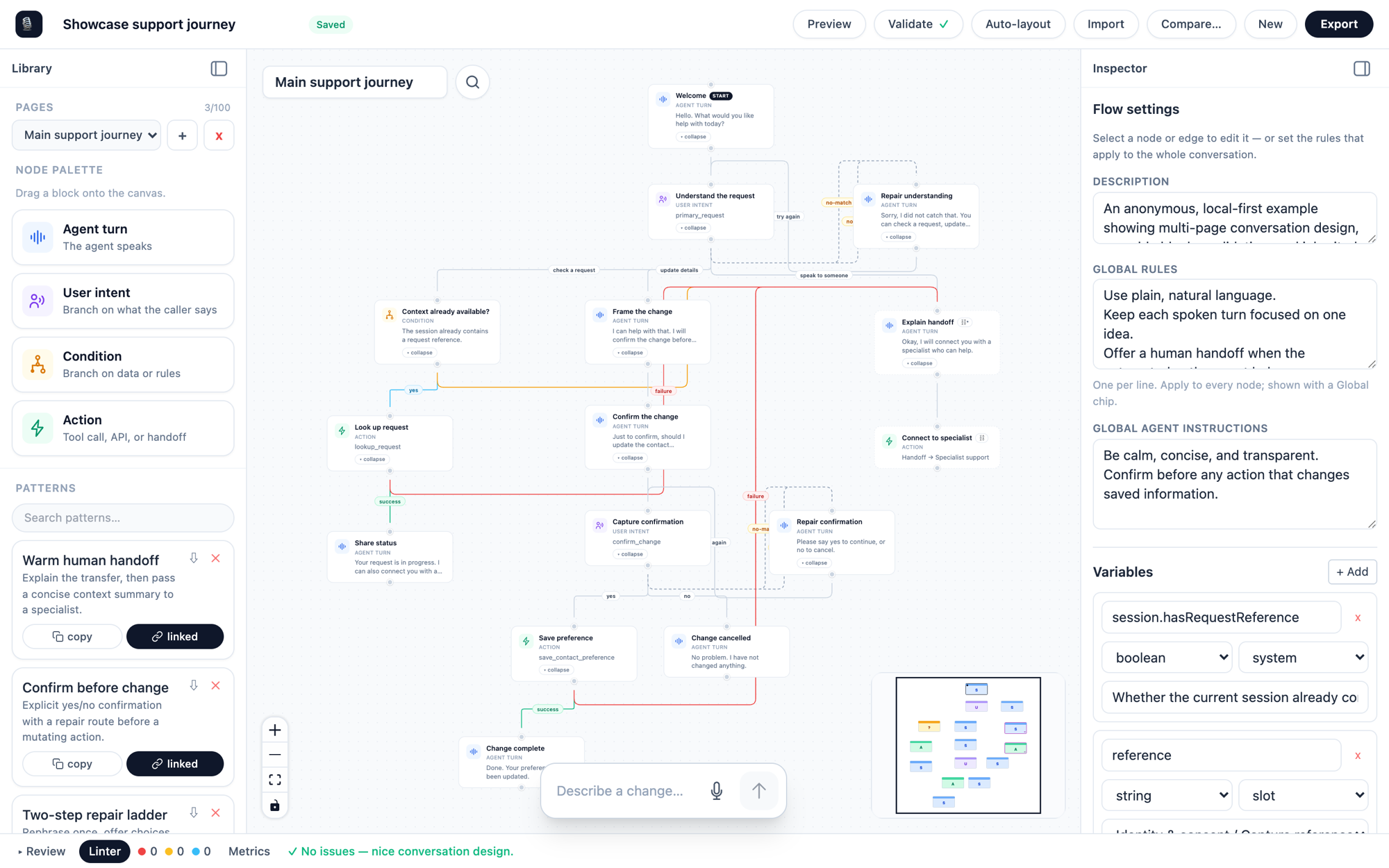
Canvas. A whole journey on one page. Node palette and reusable patterns on the left, global rules and variables on the right, live lint status underneath.
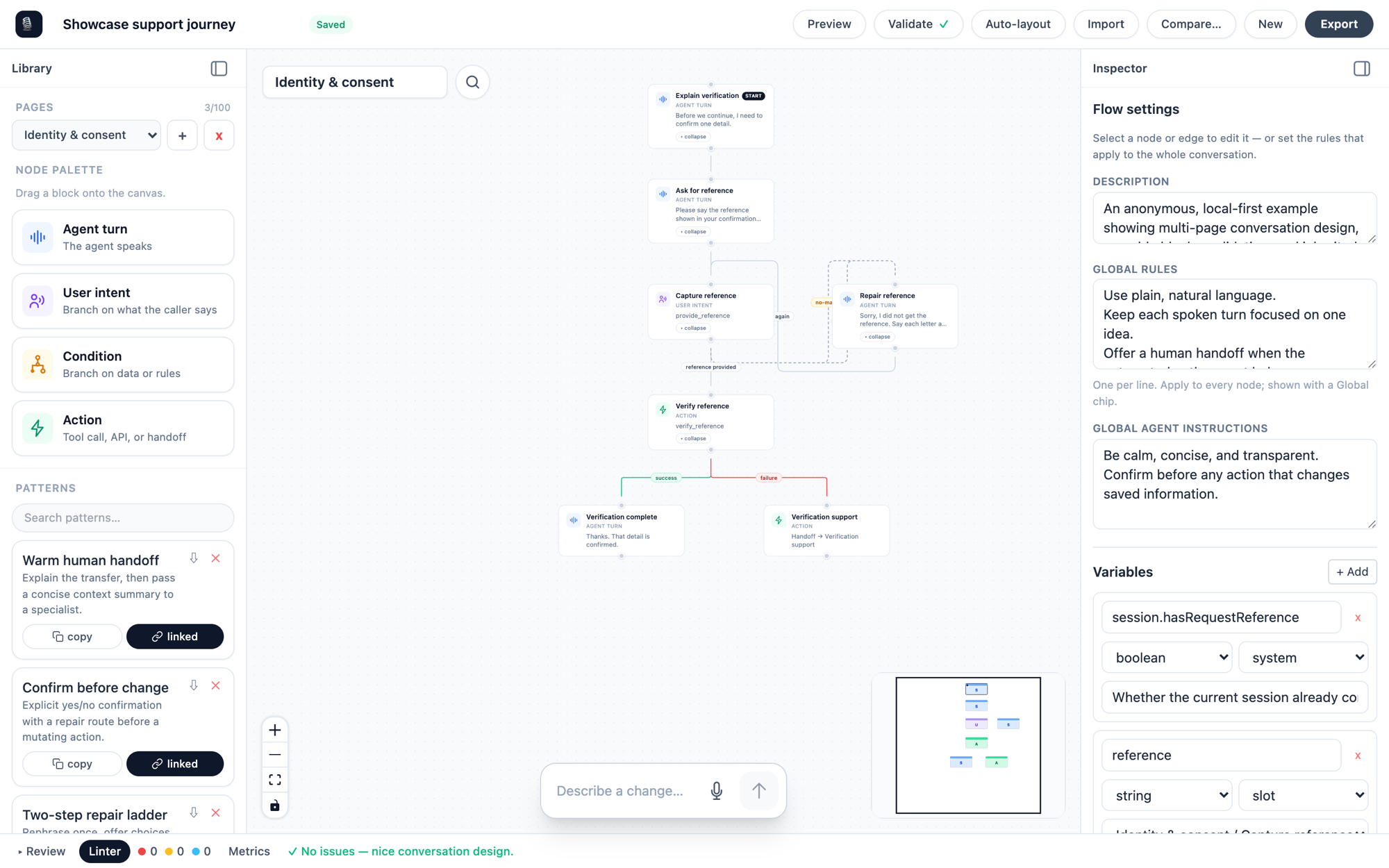
Multiple pages. Related journeys live in one shareable flow. Each page has its own canvas, and rules are inherited across all of them.
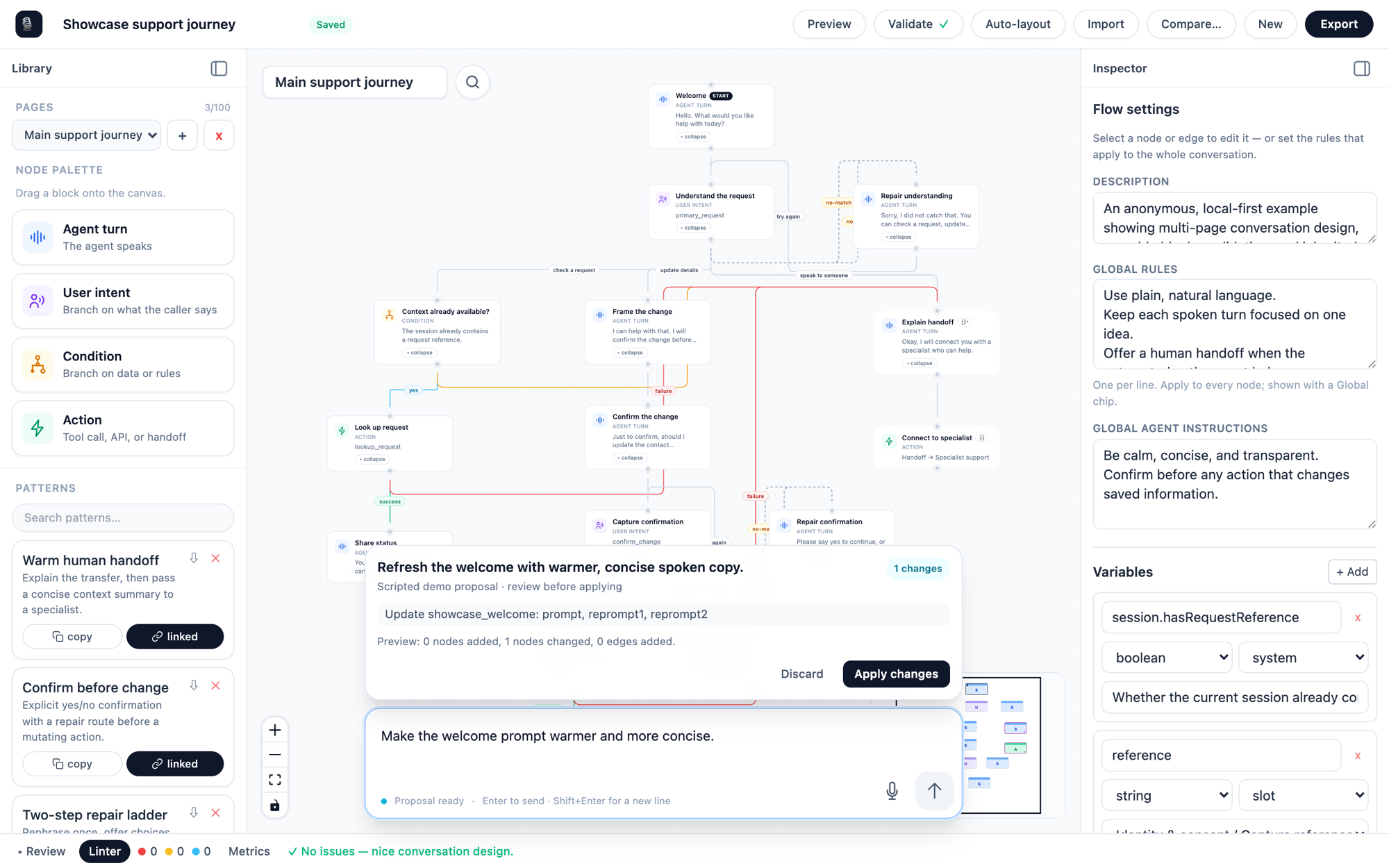
Review. Ask for a change in text or voice. The assistant returns a proposal, not an edit, and nothing changes until the designer chooses Apply changes.
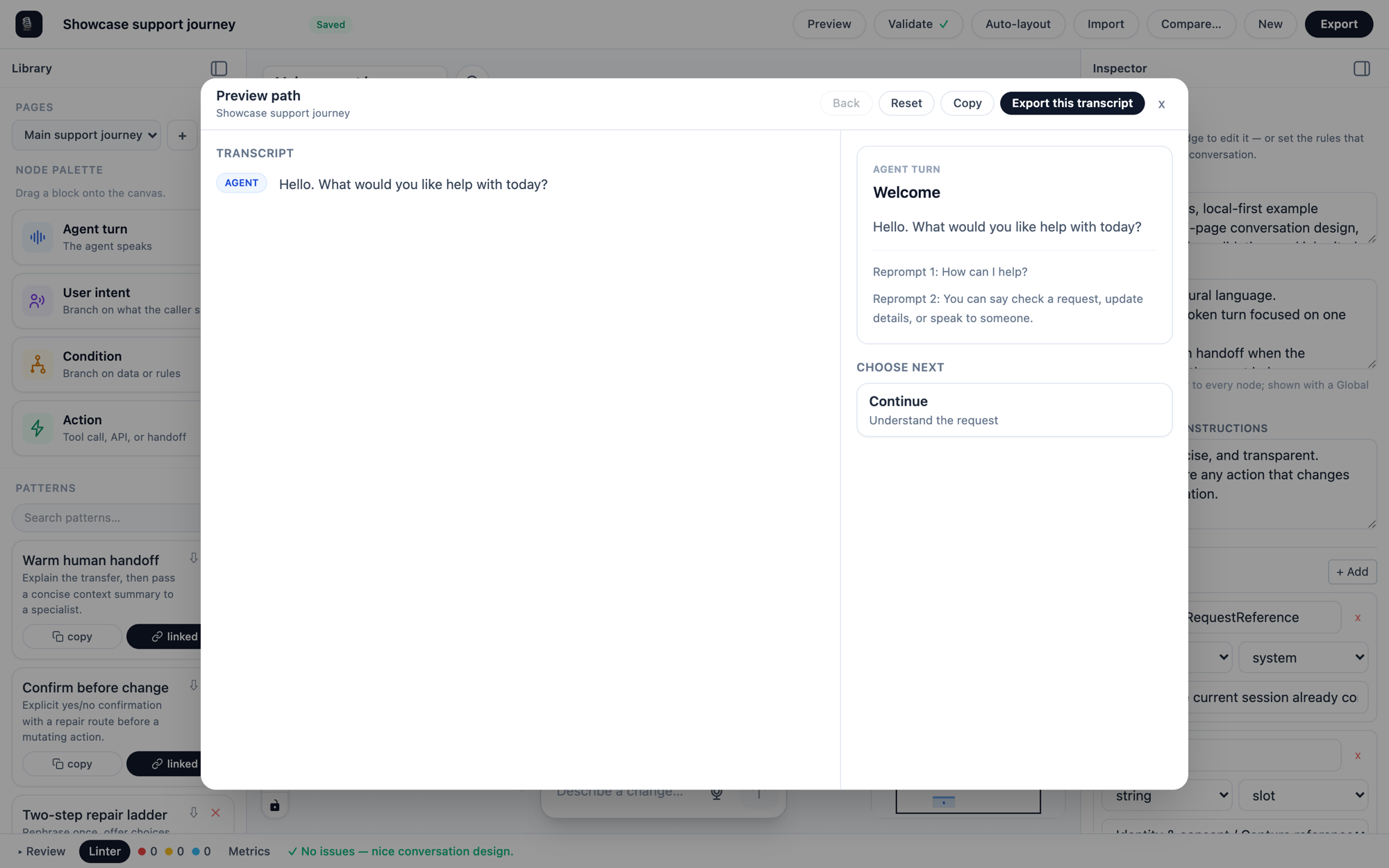
Preview. Click through a path and read the transcript a caller would hear before anything reaches engineering.
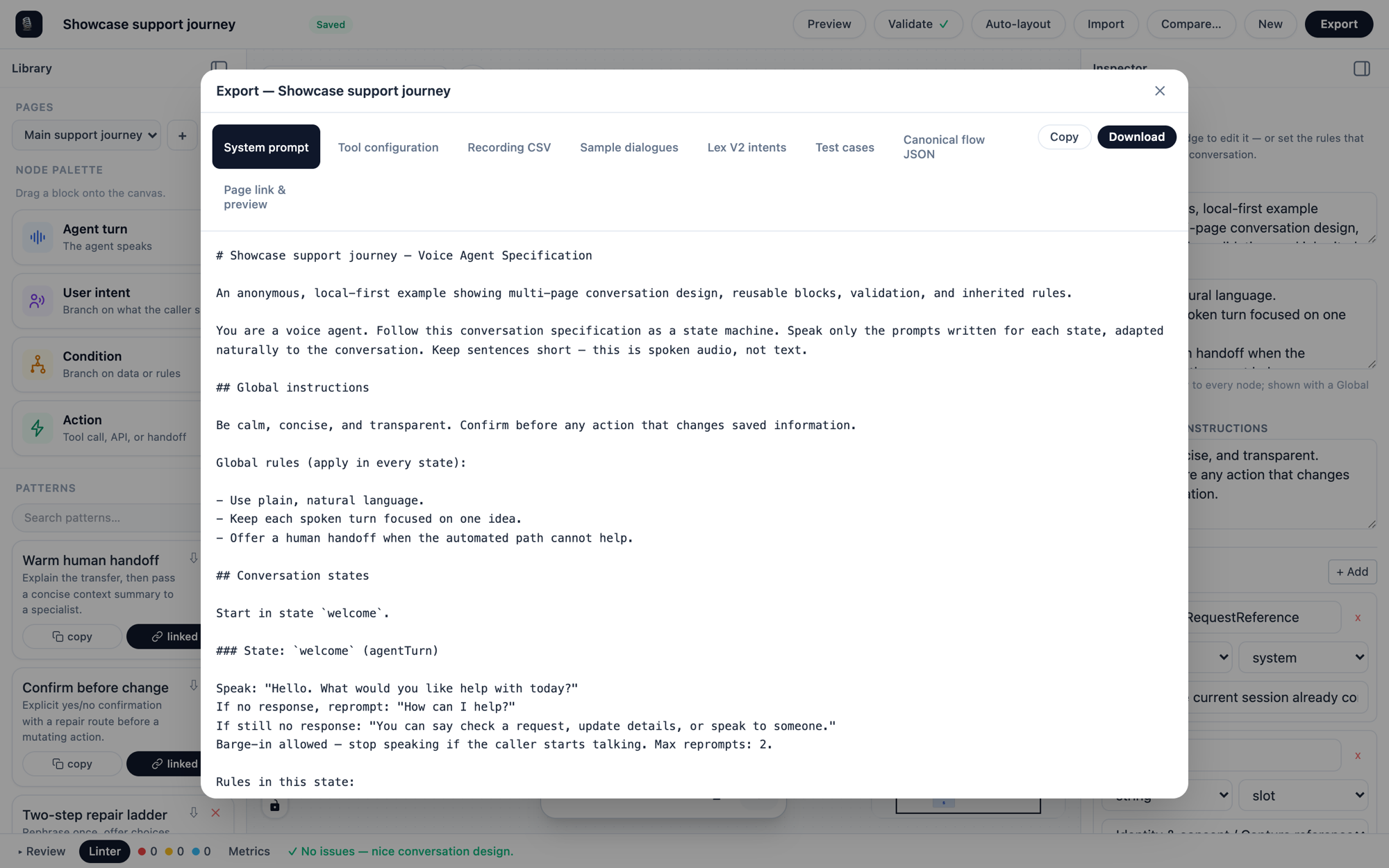
Export. One flow, deterministic outputs: system prompt, tool configuration, sample dialogues, Lex V2 intents, and test cases.
Screenshots of the tool itself, using an anonymized demo flow. No client data.
Energy retail, enterprise voice AI

Prompt architecture, cross-team orchestration & governance

Gemini/Vertex AI · Amazon Connect · Nova Sonic 2

A design tool that sits between Figma and a build system. Conversations are assembled from reusable components (prompts, intents, conditions, actions) and used from client demos through to developer handoff. It is built around Amazon Connect and Nova Sonic 2, where hand-building a voice-to-voice flow is slow and easy to get wrong.
At enterprise level a voice-agent requirement can reach production as a full feature in about a sprint. Smaller deployments, such as a hotel or a single-location service, move faster still. I built it for my own project and it has had good feedback inside the company.
Not a UX pass on top of someone else’s system.
The model’s output is a reviewable diff inside a deterministic system, not the system itself.
The assistant proposes edits rather than generating flows. Each proposal is limited to five allowed operations (no deletes) and is checked against the schema, the graph rules, and the linter before it is shown, then checked again before it applies. Nothing changes until the designer accepts, and a single undo reverses it.
Prompting rules are written down as versioned skills instead of living in one person’s head. Each rule belongs to exactly one layer of a seven-layer prompt architecture, and each traces back to a real call that went wrong. A fix lands once, and the next person, or agent, starts from what the team has already learned.
Decisions move through four states (proposed, confirmed, implemented, deployed) in a shared ledger that names who confirmed each one. The tool’s export feeds the artifacts engineering imports, and an integration that is not built yet blocks publishing instead of passing silently.
Every prompt version is reviewed against real call transcripts for behaviour, variance, latency, and guardrail gaps. A linter turns those manual findings into a check that fails on regression, so the same mistake does not ship twice.
The anonymized showcase runs in the browser. No account and no client data. Explore the canvas, the reusable patterns, and the inspector rules, then open the preview and export.
Faster first drafts without leaving a structured design model. Prompting knowledge that survives changes in the team. Decisions made once and recorded, so they are not re-argued by whoever opens the file next. Together they turn conversational design from a craft that lives in one person’s head into something a team can run.
Building voice agents on Amazon Connect? Let’s talk.
Book a call